

In this edition of our executive intelligence series, we explore key insights from the landmark Harvard Business Review study "Leadership Lessons from Great Family Businesses" (co-authored by Claudio Fernández-Aráoz, Sonny Iqbal, and Jörg Ritter). At Khuvsgul AI, we continuously deliver strategic analyses on generational family enterprises alongside breakthrough enterprise AI architectures and real-world deployment frameworks.
Critical Questions for Business Owners, Shareholders, and Rising Executives:
- ❓ How do world-class family enterprises structure enduring governance and leadership?
- ❓ How can non-family executive talent map out thriving, high-impact career paths within family-owned firms?
- ❓ How should controlling families objectively identify and prepare their next-generation CEOs?
This landmark study evaluated 50 of the world’s largest and most enduring family businesses, analyzing their corporate governance architectures, leadership development pipelines, executive succession models, and drivers of multi-generational resilience.
Each of the 50 enterprises surveyed generates annual revenues exceeding €500 million ($550M+), with the vast majority currently governed and owned by third- and fourth-generation leaders. These insights therefore reflect the battle-tested practices of market-shaping global conglomerates and diversified industrial holdings.

Study Authors: Claudio Fernández-Aráoz, Sonny Iqbal, and Jörg Ritter (Senior Advisors and Partners at Egon Zehnder).
"The central finding: For a family business to thrive across generations, it must rigorously preserve its core family values while instituting professional governance, elite merit-based management, and a disciplined succession architecture."
1. CORE CHALLENGES FACING FAMILY ENTERPRISES
It is no secret that family businesses encounter formidable hazards surrounding corporate governance, generational handoffs, and long-term existential survival.
The study highlights high-profile governance crises across global dynasties, including Portugal's Banco Espírito Santo, South Korea's Doosan Group, Italy's Fiat, and the United States' Market Basket.
These cases underscore how interpersonal friction among family members can trigger catastrophic reputational damage, operational paralysis, and severe shareholder value destruction.
Furthermore, extensive empirical research by Professor Joseph Fan of the Chinese University of Hong Kong—tracking 214 family-run firms across Taiwan, Hong Kong, and Singapore—demonstrated that during the eight-year window surrounding a CEO transition, stock valuations plummeted by an average of nearly 60%.
Yet family enterprises constitute the backbone of global commerce: approximately 80% of corporations worldwide are family-owned or controlled, including some of the most influential multinationals on earth.
2. FOUR FOUNDATIONAL LESSONS FROM THE STUDY
I. SOUND CORPORATE GOVERNANCE IS THE BEDROCK
To attract, motivate, and retain top-tier non-family executive talent, family enterprises must draw clear, unyielding boundaries between family dynamics and business operations.
A remarkable 94% of top-performing family enterprises maintain active supervisory or advisory boards, averaging nine members—with a substantial presence of independent, non-family directors who ensure objectivity.
Research indicates that one in four (25%) non-family executives harbor deep anxieties before joining a family firm, specifically concerning:
- Ambiguity over true operational autonomy and decision-making authority
- Opaque family agendas and informal backdoor influence
- Nepotism risks and unmerited familial promotions
- Emotional, irrational, or ungrounded strategic directives
Core Takeaway: While the owning family rightfully establishes long-term strategic vision and values, day-to-day operations and accountability must rest entirely on professionalized, objective systems.

II. "FAMILY GRAVITY" — PRESERVING THE CENTRIPETAL PULL OF THE CORE
One of the study’s most profound concepts is "Family Gravity".
Every great family enterprise possesses an emotional and cultural gravitational field. It reflects how one or a few pivotal family leaders anchor the firm’s core values, mission, and generational purpose.
Much like the sun at the center of the solar system, these leaders align diverse shareholder, employee, and customer interests around a unified trajectory. Such leaders characteristically:
- Prioritize generational longevity over short-term quarterly earnings
- Deeply champion the well-being of employees, clients, and local communities
- Commit steadfastly to social responsibility and sustainable compounding
- Attract and retain world-class talent through unwavering integrity and authentic values
The researchers emphasize that as family enterprises professionalize governance, they must never discard or dilute their unique cultural identity and emotional soul.

III. EARLY IDENTIFICATION AND CULTIVATION OF FUTURE LEADERS
Exemplary family enterprises never treat leadership succession as an automatic entitlement or birthright.
Before answering the perennial question of "who should lead next," top organizations evaluate prospective leaders—both family members and high-performing non-family executives—against three objective dimensions:
| Evaluation Dimension | Core Attributes & Focus Areas |
|---|---|
| Competencies — Capability | Strategic agility, market acumen, commercial instinct, results-driven execution, and cross-functional team leadership. |
| Potential — Growth Runway | Curiosity, adaptability, intellectual resilience, and capacity to handle progressively complex and ambiguous environments. |
| Values — Character Alignment | Uncompromising integrity, humility, deep respect for colleagues, passion for excellence, and commitment to generational purpose. |
More than 40% of surveyed firms systematically integrate next-generation family members into Board and committee workflows to hone strategic acumen. Many rotate rising successors through frontline roles in sales, innovation, corporate development, and product operations.
Simultaneously, world-class family firms place identical emphasis on developing high-potential non-family executives, recognizing that external professional excellence is integral to the enterprise core.
Core Takeaway: Executive leadership is an earned responsibility, not an inherited birthright. It requires demonstrable competencies, aligned values, and years of deliberate preparation.
IV. SYSTEMATIC CEO SUCCESSION PLANNING
Appointing a new Chief Executive Officer is the single highest-stakes milestone in a family firm's lifecycle. Approximately 70% of companies falter during this transition, with publicly traded firms often witnessing severe market capital erosion.
Even among elite family enterprises surveyed, nearly 30% considered only a single candidate, and nearly two-thirds lacked an institutionalized, fully structured selection process. Relying on a narrow candidate pool or informal intuition poses grave enterprise risks.
Based on decades of executive data across global organizations, the authors outline a Three-Phase Disciplined Succession Process:
| Succession Phase | Key Actions & Milestones |
|---|---|
| Phase 1: Shareholder Alignment & Strategic Direction | Comprehensive discussions among shareholders regarding the enterprise's multi-year vision, succession scenarios, governance charters, and clear competency profiling for the incoming CEO. |
| Phase 2: Comprehensive Candidate Evaluation | Benchmarking both internal talent (family & non-family executives) alongside vetted external candidates through structured interviews, psychometric evaluations, and thorough reference audits. |
| Phase 3: Integration, Onboarding & Development | Establishing clear 6-to-12-month performance milestones, defining senior executive team dynamics, conducting a 360° leadership evaluation at 12 months, and reviewing multi-year strategic execution over 24 months. |
3. THREE ARCHETYPES OF NONFAMILY CEOS
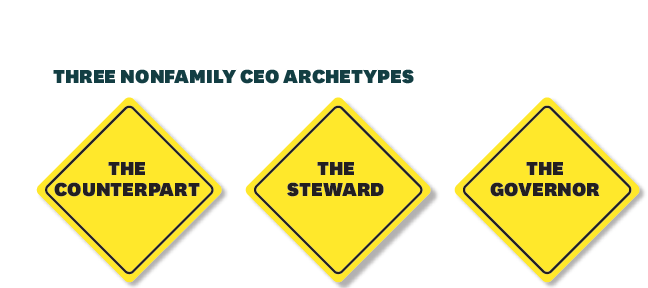
When a family enterprise elects to appoint an external Chief Executive Officer, the study categorizes successful non-family CEOs into three distinct archetypes:
| CEO Archetype | Core Operational Role & Organizational Fit |
|---|---|
| The Counterpart — Strategic Peer | Acts as a peer and strategic thought partner with key family principals, co-architecting major transformations and eventually transitioning into full executive autonomy. |
| The Steward — Heritage Custodian | Executes the controlling family’s long-term vision with consummate managerial discipline, preserving institutional continuity and safeguarding founding values. |
| The Governor — Operational Director | Drives day-to-day operational execution strictly within clearly codified, predefined governance boundaries established by the board. |
The paramount insight here is that no single CEO archetype fits every family business. The optimal leader depends directly on ownership goals, board composition, and the firm’s development stage. A CEO who achieved stellar success elsewhere may fail dramatically if their archetype mismatches your family's governance reality.
THE INTERSECTION OF EMOTION, CAPITAL, AND LEGACY
What makes family business so endlessly compelling is that corporate destiny is never dictated solely by balance sheets, EBITDA, or market share. Familial bonds, generational inheritance, trust, and interpersonal friction can decide the future of multi-billion dollar enterprises.
In our upcoming editions, we will analyze dramatic real-world cases from Hong Kong, the United States, and Germany—examining how families navigated explosive intra-family disputes, the tangible financial risks incurred, and proven governance playbooks to insulate businesses from family turmoil. Stay tuned with us.